

Bridge Play Basics
Free Finesse?
This is a deal from BBO’s Bridge Master – an interactive declarer-play tool available on the ACBL website at Bridge Master.
Test your play!
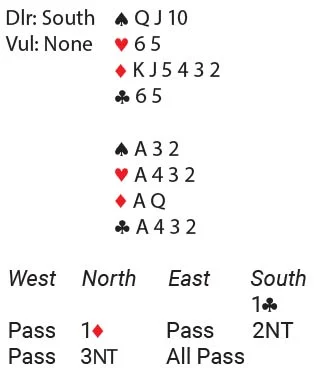
A note on the bidding: With 18 high-card points, South is too strong to open 1NT (15–17). As South, you should start with the longer minor, then rebid 2NT to show 18–19. (A 2NT opener shows 20–21.)
You are in 3NT with the ♠7 lead: 10, 5 … what card do you play?
Beware of cheap tricks! Because you have no other entry to dummy’s long ♦diamonds, you must win the ♠A at trick one. This layout shows why you should do this:

After winning the ♠A, unblock the ♦A Q and play another spade. Whether West or East holds the king, you have another entry to dummy if they take the king. You’ll win the next trick and get to dummy with a spade and play all your diamond tricks. You emerge with an overtrick: six ♦diamonds, two spades and the ♥A and ♣A.
Note that if you allow the ♠10 to win at trick one, you’ll go down on this layout. If you next unblock the ♦A Q, you can’t get back to the dummy to run the diamonds. And you can’t afford to play the ♦A and overtake the ♦Q with the king because East has a stopper in the suit.
Best Bidding
More on Doubles
All-star teacher and Bridge Bulletin columnist Larry Cohen spent 2022 and 2023 covering takeout and negative doubles. In case you missed it, all columns are available online via the MyACBL portal. (Instructions at the end of the column.)
Last month, we reviewed Larry’s column on the basic takeout double, which promises 12–17 high-card points (HCP) and support for the unbid suits.
Another possibility for the takeout double is a hand with 18+ HCP, also known as the “power double” or the “big double.” When you have a hand with extra strength, you show it by starting with a double and then bidding again. Your second bid clarifies the strength and distribution of your hand. The “big double” does not promise support for the unbid suits – it could be a hand that is simply too strong to overcall – because an overcall is not forcing.
Is it forcing when you double and bid again? Usually, no. The range is roughly 18–21. If your partner is really broke, he can pass after you double and then bid. So, if you have even more (you want to be in game opposite a dead minimum), you must do more.
To summarize: When you double with 12–17 HCP, you will likely just pass whatever partner bids unless partner shows values (such as by jumping a level). But with 18+, you will bid again.
Even this low-level auction shows a hand too good to overcall 1♠:
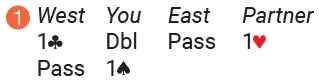
You might have something like:
♠A Q 10 8 7 ♥A K 2 ♦A Q J ♣3 2.
Note that with 12–17 HCP, it is dangerous to take another call, especially a “free bid,” because it shows a strong hand.

Even this simple raise should promise more than a minimum takeout double, something like:
♠A Q J 7 ♥K 2 ♦6 5 4 ♣A K J 5.
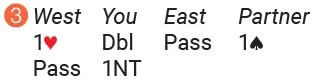
If the normal notrump overcall range is 15 to a bad 18 HCP, then this shows a balanced hand with hearts stopped that is too good to overcall 1NT, therefore the range is a good 18 to 20 HCP:
♠A K 3 2 ♥A 4 3 ♦A J 3 ♣K 10 8.
Doubling and then bidding 2NT would show 21–23 HCP.
(A direct 2NT bid is commonly used as an artificial call promising the two lowest unbid suits or both minors.)
The ACBL website offers a treasure trove of resources. Some are kept in a members-only section of the website called MyACBL. It’s via this portal where you can find the online Bridge Bulletin, with all issues going back to 2005 available. There is also a lot of personalized data.
To view any of these items, you must be logged in. Start by going to acbl.org and look for the MyACBL Login button at the top of the page. Click to log in. You will be taken to the login screen.
If you have already set up your MyACBL account, simply type in your member number and password in the appropriate fields and click the blue “Log In” button. If you do not yet have a MyACBL account, you can set it up by clicking “Register for MyACBL.”
You can also reset a forgotten password from this screen by clicking “Forgot Password.”
