

Bridge Play Basics
Severing Communication
Say you are South declaring 4♠ on the following auction:
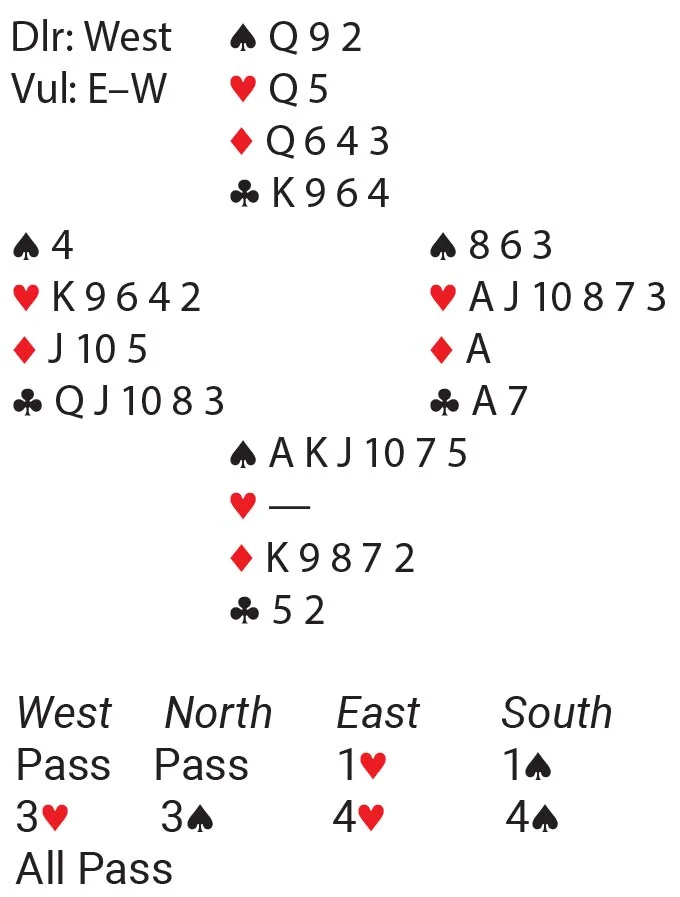
West leads the ♣Q.
Say you cover with dummy’s king and East plays the ♣A, then cashes the ♦A. East next plays a low club to West’s jack and now a diamond return gets ruffed. Down one.
Is there anything you could do better?
East made a good lead, knowing there wasn’t much hope for getting a lot of heart tricks. The lead of the ♣Q promises the jack – a potential entry. When South covered with the king, West had an easy play: Cash the singleton ♦A and lead a club to West, hoping for a ruff.
South can assure the contract by ducking the first club. Now there is no entry – the communication between the West and East hands has been severed.
Another way to think about this: East is likely to hold the ♣A to open the bidding. (And West is unlikely to have underled an ace against a suit contract.) So, covering the ♣Q can’t gain.
Best Bidding
Doubles
All-star teacher and Bridge Bulletin columnist Larry Cohen spent 2022 and 2023 covering takeout and negative doubles. In case you missed it, all columns are available online via the MyACBL portal. (Instructions at the end of the column.)
A basic takeout double promises 12–17 high-card points and support for the unbid suits. (Another possibility is a hand with 18+ HCP, which will be addressed later.)
Larry started off with direct-seat takeout doubles at the one level:
Direct seat: Your right-hand opponent bids, and you are next to bid. You are in the “direct seat.”
Takeout double: A conventional call that shows support for the three unbid suits. It is not a penalty double.
One level: Your RHO opened at the one level in a suit, either 1♣, 1♦, 1♥ or 1♠. An opening bid of 1NT does not apply as many doubles of 1NT are conventional.
To make a takeout double of a one level opening bid you need about 12 or more HCP and at least three-card support for the unbid suits.
When evaluating your hand for a takeout double, consider the following:
Shape/distribution: Extra length in the unbid suits and shortness in the opponent’s suit is always better.
Location of honors: Ideally, touching honors in long suits and no wasted values in short suits.
Vulnerability: If your RHO opens 1♠, keep in mind your double is forcing partner to bid at the two level (assuming LHO passes).
Position: Did partner pass in first seat? You might want to have a good hand to get into the auction.
RHO opens 1♣. What is your call with:
♠K Q 10 7 ♥A J 9 8 ♦Q 7 6 5 ♣2?
RHO opens 1♠. What is your call with:
♠2 ♥A 10 8 7 ♦A 10 8 6 ♣K 10 8 5?
RHO opens 1♦. What is your call with:
♠A Q 10 ♥A Q J ♦5 4 ♣J 8 7 6 5?
Larry recommends a double with these hands. Even though the second hand has only 11 HCP, it has two aces and a singleton. The third hand is an example of bringing all three suits into play with a double, rather than overcalling a lousy five-card suit.
The ACBL website offers a treasure trove of resources. Some are kept in a members-only section of the website called MyACBL. It’s via this portal where you can find the online Bridge Bulletin, with all issues going back to 2005 available. There is also a lot of personalized data.
To view any of these items, you must be logged in. Start by going to acbl.org and look for the MyACBL Login button at the top of the page. Click to log in. You will be taken to the login screen.
If you have already set up your MyACBL account, simply type in your member number and password in the appropriate fields and click the blue “Log In” button. If you do not yet have a MyACBL account, you can set it up by clicking “Register for MyACBL.”
You can also reset a forgotten password from this screen by clicking “Forgot Password.”
