
Play of the Hand Tips
Do You Need to Finesse?
This is a deal from Bridge Master, a free, interactive declarer-play program on Bridge Base Online, illustrates the concept of rejecting a finesse that you don’t need to take:

On the lead of a trump, what’s your plan? Say you win the lead, draw all the trumps and take the diamond finesse, which loses on this layout. You must lose the two black-suit aces, too, and you’ll be stuck with a low diamond loser in your hand. Down one.
If West holds the ♦K, a finesse will work. But what if the finesse loses to East and he returns another trump? You can try a diamond to the ace, but you have no way back to your hand to ruff a diamond. If you play a club or a spade, East will hop up with the ace and play a third trump, leaving you with a diamond loser and, again, down one.
Instead of taking the diamond finesse, at trick two simply play to the ♦A, then play the ♦Q. If the defense wins the ♦K and continues with another trump, you win and ruff your third diamond. Now you can play a spade or a club, losing to the ace, and win the continuation. Be sure to pull the last trump and make your game with 10 tricks.
Best Bidding
More on Doubles
All-star teacher and Bridge Bulletin columnist Larry Cohen spent 2022 and 2023 covering takeout and negative doubles. In case you missed it, all columns are available online via the MyACBL portal. (Instructions at the end of the column.)
So far, we’ve reviewed Larry’s column on the basic takeout double, which promises 12–17 high-card points (HCP) and support for the unbid suits, and the “big double,” a hand with 18+ HCP. In both of those situations, the double was a “direct seat” action, meaning that the doubler’s right-hand opponent had opened the bidding:

What about if partner passes and both opponents bid?
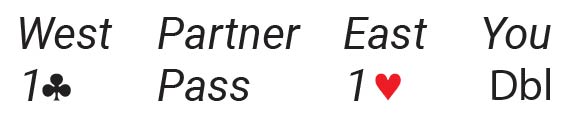
This double should promise the same strength parameters and support for the unbid suits. In this case, there are only two. It’s possible that the doubler could be somewhat balanced, but will typically be at least 4–4 in spades in diamonds, something like:
♠A Q 10 4 ♥ 5 4 ♦A K 6 5 ♣10 8 7.
With five spades and four diamonds, overcall the spade suit:
♠A Q J 7 6 ♥5 4 ♦A J 7 6 ♣3 2.
With four spades and five diamonds, prefer to double so you don’t lose the spade suit:
♠A Q 8 7 ♥5 4 ♦A J 8 7 6 ♣8 6.
What about when their suit has been bid and raised?

The doubler should have good values and/or shape, because if partner doesn’t have spades, then they will have to bid a minor suit at the three level.
♠A Q 8 7 ♥2 ♦K 10 8 7 ♣Q 10 8 7
♠K Q 10 5 ♥3 2 ♦A Q 2 ♣K 8 7 6
Is anything different in the balancing seat (sometimes called the pass-out seat)?

“Borrow a king” is a common saying, meaning that you can have about 3 HCP less than normal for a balancing double. So, your range becomes 9–14 HCP, not 12–17. Double with:
♠Q 10 8 7 ♥2 ♦K 10 7 6 ♣K J 7 6
♠K Q J ♥3 2 ♦A 10 7 6 ♣9 8 6 5
♠K 8 7 2 ♥A ♦Q 8 7 6 ♣J 7 6 5
The ACBL website offers a treasure trove of resources. Some are kept in a members-only section of the website called MyACBL. It’s via this portal where you can find the online Bridge Bulletin, with all issues going back to 2005 available. There is also a lot of personalized data.
To view any of these items, you must be logged in. Start by going to acbl.org and look for the MyACBL Login button at the top of the page. Click to log in. You will be taken to the login screen.
If you have already set up your MyACBL account, simply type in your member number and password in the appropriate fields and click the blue “Log In” button. If you do not yet have a MyACBL account, you can set it up by clicking “Register for MyACBL.”
You can also reset a forgotten password from this screen by clicking “Forgot Password.”
