

What’s your call?
| 2NT | ||||
| 3♣ | 3♦ | 3♥ | 3♠ | 3NT |
| 4♣ | 4♦ | 4♥ | 4♠ | 4NT |
| 5♣ | 5♦ | 5♥ | 5♠ | 5NT |
| 6♣ | 6♦ | 6♥ | 6♠ | 6NT |
| 7♣ | 7♦ | 7♥ | 7♠ | 7NT |
| Pass |
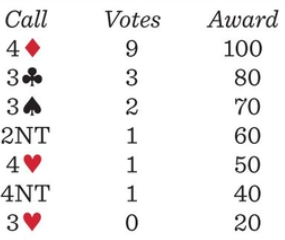
After partner’s fit-showing cuebid, Pavlicek likes a 4♦ splinter. “Despite the reduced value of the ♠K, a conservative 4♥ will miss some laydown slams. On a good day, I’ll draw 4♠ next from partner, then Blackwood …”
Robinson, too: “Lets partner know that I have a good hand with diamond shortness.”
Rigal rants (and rants and rants) and eventually bids 4♦ . “This hand demonstrates the flaw in standard bidding. Modern science uses 2NT for four-card raises, and I also use a jump to 4♣ as specifically a balanced raise to game – nothing to do with clubs. So the cuebid is more or less than game, typically with three trumps. Partner doesn’t know if a splinter is slammish facing a limit raise or just catering to a slam try. Anyway, rant over. I bid 4♦ as a splinter and run the risk that we might get too high facing the wrong spade holding.”
Falk rants more constructively. “4♦ , splinter. If partner has nothing in diamonds, we can easily have slam – two aces and some club length should do it given heart support. This also strongly implies spade control.”
4♦ by Sanborn: “This is potentially a great hand. 4♦ should imply controls and slam interest.”
Ditto Lee: “I don’t think there’s a serious alternative to showing slam interest with diamond shortness.”
Korbel splinters. “The ♠K has decreased in value, but if the diamond splinter excites partner, we may be in business. Picture:
♠A x ♥A x x x ♦ x x x x ♣Q x x.”
For reasons known only to him – likely too much likker – Weinstein’s country bumpkin alter ego puts in an appearance. “4♦ . No reason not to splinter. We gots a good hand for slammin’. Pass the moonshine.”
Meckstroth makes a forcing 3♣ call to try to get more information from partner. “I can always bid Blackwood later.”
Same with Cohen, who bids 3♣. “For now. Let’s leave maximum space for further exploration.”
There’s always a cuebidder (or two, in this case) in the crowd.
3♠ by Meyers: “I have a huge hand when partner shows a heart fit. We could easily have a slam.”
Stack is the other. “This is a great hand with controls in all suits, so let’s use a cuebid to send partner a message that we have slam interest. I have admiration for a 4♦ splinter, but that also leaves partner no room to cuebid.”
Hampson waits with 2NT. “I want to give partner room to describe his hand. He may have more than just game interest.”
The Sutherlins use 4♣ conventionally. “Partnerships may have many different agreements on how to proceed – 4♣ as a slam try in hearts and 4♦ as a slam try in spades. If we don’t bid 4♣, opponents might preempt us.”
Boehm bids 4♥, without comment.
Whether partner has the limit raise or he has better, Lawrence is happy launching Blackwood. “My partners always have the better hand because when they have a limit raise, they make a limit raise. My partner also promises four trumps.”
