
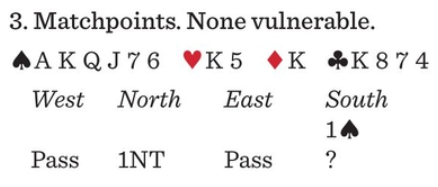
What’s your call?
| 2♣ | 2♦ | 2♥ | 2♠ | 2NT |
| 3♣ | 3♦ | 3♥ | 3♠ | 3NT |
| 4♣ | 4♦ | 4♥ | 4♠ | 4NT |
| 5♣ | 5♦ | 5♥ | 5♠ | 5NT |
| 6♣ | 6♦ | 6♥ | 6♠ | 6NT |
| 7♣ | 7♦ | 7♥ | 7♠ | 7NT |
| Pass |
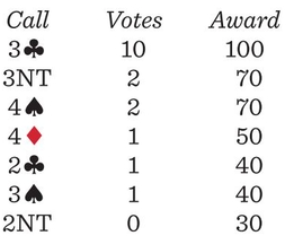
Most of the crowd goes old school with a game-forcing jump shift.
Robinson makes it sound so simple. “3♣ – forcing to game and shows clubs and spades.”
Pavlicek bids 3♣. “I can always bid 4♠ later, but I want to keep 3NT in the picture. Over three of a red suit, I’ll bid 3♠ to leave another window for 3NT.”
3♣ by Colchamiro. “Isn’t 3♣ followed by 4♠ the textbook way to bid this hand?”
Sanborn: “I’m too good for 3♠, but I don’t quite have a 3NT bid. Maybe 4♠ would work better, but I’ll be oldfashioned.”
Meckstroth: “I will pass 3NT if partner bids it.”
3♣ by Lee: “Several offbeat options have some appeal, but this is the closest I can get to describing my hand and involving partner.”
The Sutherlins, too: “We have enough to invite slam, but because we may be off two aces, we need to proceed carefully.”
Rigal: “I have enough to force to game despite the broken reed of the stiff ♦ K, and especially so that we can actually describe what we have. We can always bid 4♠ over 4♣.”
3♣ by Meyers. “This hand is worth forcing to game.”
Hampson, 3♣: “I could bid 3NT, but even when they lead wrong, I may not have a ninth winner.”
Boehm’s 3♣is flexible. “Destination 4♠, 3NT or 6♣. The game-forcing jump shift keeps all doors open.”
Weinstein says 3NT describes this hand. “Choice of games with a balanced hand and six good spades. We’d bid 2NT with 18–19 and 5–3–3–2 distribution. I’m choosing to treat this as balanced, thanks to the singleton ♦ K.”
“Why mess around?” asks Korbel as he plunks 4♠ on the table. “We will probably have play for this. At IMPs, I might try 3♣ to look for a magic slam.” Stack bids 4♠. “It is tempting to bid 3NT, but this hand looks like it will make more in spades because of the 6–4 distribution.”
Falk rebids a humble 2♣. “Even if the worst happens and partner passes 2♣, the auction is not over – someone has a lot of red cards. A jump shift on this ‘19-point’ hand is ridiculous – I might not be able to make 1♠ let alone force to game. 3♠ is not terrible, but partner will have no way to evaluate meager values intelligently.”
Cohen is content with 3♠. “No reason to insist on game at this form of scoring. Why can’t partner have something mundane like:
♠x x ♥J x x x ♦ A x x x ♣J x x?
Can’t risk 2♣ with such great spades.”
Lawrence chooses 4♦ as a self-splinter for spades. “Shows mild slam interest.”
