
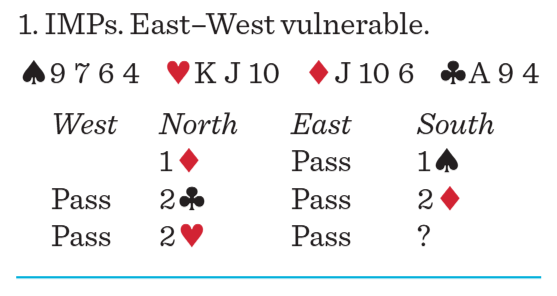
What’s your call?
| 2♠ | 2NT | |||
| 3♣ | 3♦ | 3♥ | 3♠ | 3NT |
| 4♣ | 4♦ | 4♥ | 4♠ | 4NT |
| 5♣ | 5♦ | 5♥ | 5♠ | 5NT |
| 6♣ | 6♦ | 6♥ | 6♠ | 6NT |
| 7♣ | 7♦ | 7♥ | 7♠ | 7NT |
| Pass |
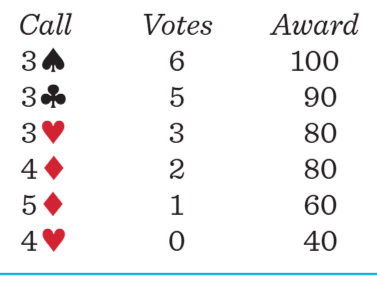
A lot of you are probably scratching your heads and wondering why on earth 3♠? When you hear what it means, you’ll agree 3♠ is a very cool bid.
Falk explains. “This is the perfect hand and opportunity for a Bluhmer (named for the late Lou Bluhm): a jump in a suit I previously declined to rebid, which thus cannot show good or long spades. With good spades I might bid notrump; with long spades, I’d have bid 2♠ on the second round. My bid actually shows terrible spades, but announces that I have surprisingly useful extra values for partner. Partner has shown something like 1=3=5=4 or 0=3=6=4; I suppose 1=4=4=4 is possible. I don’t think 0=4=5=4 is possible, as partner would have reversed into 2♥ and bid clubs later holding enough values to try for game. So far I have promised nothing. I could have:
♠K J x x x ♥J x x ♦x x ♣J x x.
Instead I have three of the top five hearts, two of the top five diamonds and the ♣A: 9 golden high-card points. Plus two 10s! I’m expecting partner to have something like:
♠— ♥Q x x ♦A K Q x x x ♣K Q J x
where 6♦ is easy.”
Robinson agrees. “3♠ – a Bluhmer – a jump in a suit that can’t possibly be logical shows that you have all of your strength outside that suit. If partner is void in spades we should have a slam and he’ll know it.”
Sanborn has a different name for 3♠. “This is what we used to call an ‘out of the blue cue.’ I have enough to accept game with great fillers in all of partner’s suits, but I don’t know which suit to play. If partner has a five-card minor, we surely belong there, but with 1=4=4=4, our best shot at game could be 4♥. I’m not thinking that partner will play me for a heart fit and a slam try after a mere two-level preference.”
Rigal has absolutely no respect for this panel! He bids 3♠. “OK, I know I’m going to score zero, but it is worth it to explain what is technically the right call here. Your partner has shown short spades so spades cannot be trump. 2♠ is waiting bid suggesting a non-minimum; 2NT/3♣ /3♦ /3♥ are all non-forcing; and 3♠? It is a Bluhmer showing the best possble hand for the auction with no wasted values in spades. Imagine:
♠— ♥A Q x x ♦A K x x x ♣K x x x.
Here, you go down in 3NT when 6♦ is where you want to be.”
Boehm Bluhmers, too. “If not allowed in this club, then 4♣.”
Boehm brings up an interesting point: A Bluhmer is not really a convention that can be allowed or disallowed, but rather an extension of bridge logic. And while this treatment may take a little more time at the table to think of or field, its meaning is the only reasonable interpretation opposite a known three-suited hand.
Cohen, who bid 3♣, ponders, “I wonder if anyone will mention a Bluhmer. I have to make some forward-going move, and I hope this is construed as that move and not a preference following a false preference.”
Meckstroth, 3♣. “I’m not clear what to bid here. I have a great hand for partner. We can’t play this in notrump. Hearts may be our best spot.”
Meyers: “3♣, which is forcing. If I wanted to ‘get out,’ I would re-preference diamonds. If partner now bids 3♦, I will bid 3♥.”
Colchamiro uses 3♥ to say all of the above. “My hand has become enormous opposite what seems like a stiff spade. Whatever partner’s game for, I’m in.”
Benedict, 3♥: “Partner is inviting game and all my values are working. 4♥ is possible, but that would sound like I had four-card support.”
Pavlicek and Lee use 4♦ to describe this hand.
Pavlicek: “Partner’s bid should be shape-descriptive, though he doesn’t necessarily have four hearts (1=3=5=4 most often) so notrump is untenable. Even if partner has four hearts, 4♥ would probably require 3–3 trumps with the obvious spade tap, so I’ll aim for the obvious.”
Hampson goes one better… or rather one higher. “5♦. I think this is likely to be a good contract or close, and I have no real hope for more.”
