

Declarer Tips
Planning the play
Have you tried the ACBL Online Community Games for players with fewer than 50 masterpoints? Join us for a fun, casual game followed by a mini-lesson on Zoom – all with players at your skill level! Each week has a new theme for both games and lessons.
Details are here.
If you miss a game or need to come back to refresh your memory, the lessons and a cool, interactive replay feature are also available. Check out the lesson below from the Oct. 19 game:
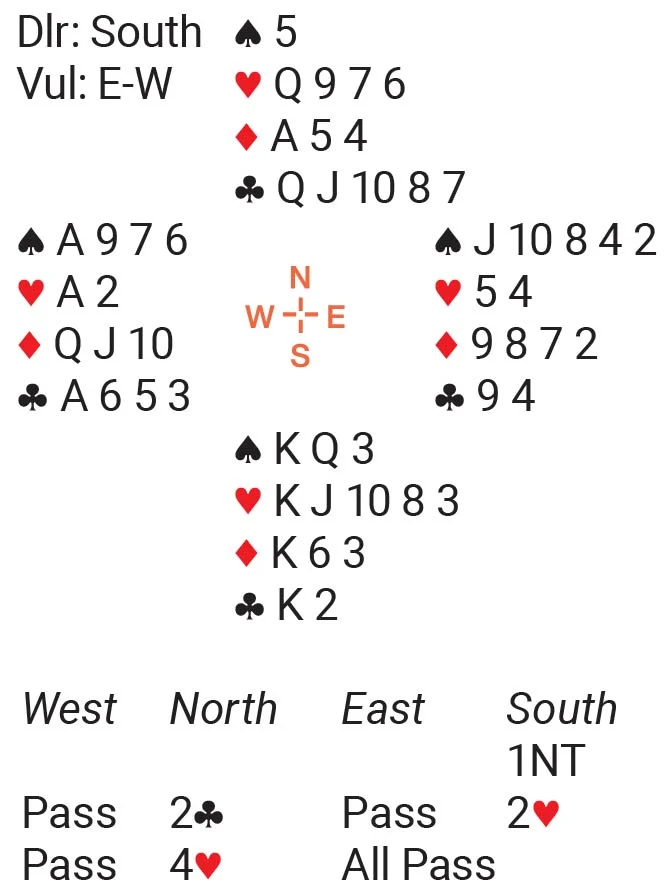
Auction Commentary: Some partnerships have agreements that they will not bid notrump holding a five-card major. Make sure you and partner have an agreement about this, so you’ll both be on the same page.
Opening Lead: ♦Q (the top of an honor sequence).
Planning the Play: Counting losers in a suit contract, declarer sees one spade loser, one heart loser, one diamond loser and one club loser – one too many.
Where to eliminate one? The diamond is a “slow loser” – meaning that the defenders can’t take their trick in that suit right away. You have first- and second-round control – the ♦A K. If you promote the ♠Q to a winner before they can lead a third diamond, you will be able to discard the losing diamond on the ♠Q.
Important: At the beginning of the play, the only sure transportation to the South hand is the ♦K. You’ll need that to get to the ♠Q. So, plan to win the opening diamond trick in the dummy. “Second hand low” does not apply to declarer. It’s very important to plan the transportation before you play to trick one!
So the play goes like this: Win the ♦A in dummy and immediately play a spade to the king. West will win the ♠A and continue with the ♦J. You’ll win the ♦K in your hand and cash the ♠Q, discarding the losing diamond from dummy. Only then will you draw trumps.
Bridge Term Breakdown
Transportation
What is “transportation” in bridge? It’s a term used to describe how to move back and forth from one hand to another. It’s also sometimes referred to as “communication.” Think of it as how the two hands can “talk” to each other.
When declaring a suit contract, your options for transportation include leading trump to the opposite hand, leading to honor cards in the opposite hand, or ruffing (trumping) cards in the opposite hand. In notrump, transportation, or “entries,” can be more complicated:
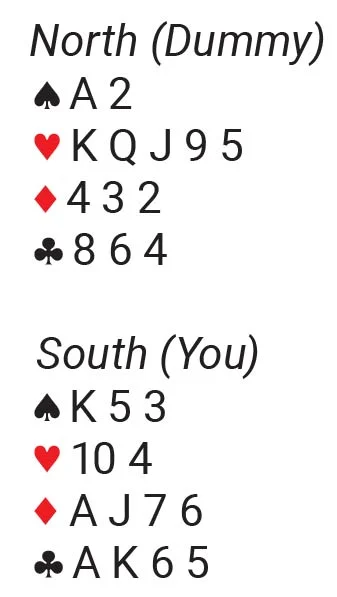
Say you are South, declaring 3NT on a spade lead. Maybe you’ve heard the maxim, “play the high card from the short side,” and think it’s right to win with the ♠A in dummy, then start playing hearts. Unless the opponent with the ♥A takes the first heart, however, you have no way back to dummy for the heart winners. Therefore, you should win the first trick in hand with the ♠K, then knock out the ♥A. When the defenders win the ♥A, you’ll regain the lead and you’ll have the ♠A as an “entry” to get to the good hearts.
Good declarer play means thinking ahead a few tricks and planning the play to ensure you have a way to get to where you want to be.
Best Bidding
Jacoby transfers
A useful bidding tool is the Jacoby transfer, used in response to an opening bid of 1NT or 2NT. When responder has a five-card or longer major and partner opens 1NT or 2NT, responder bids the suit below their suit, transferring partner into the long major.
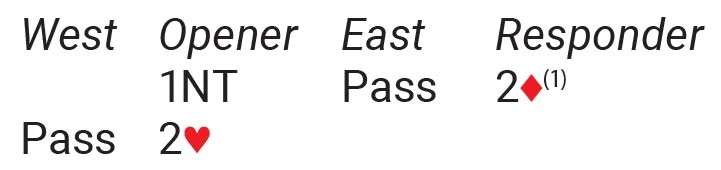
(1) Five or more hearts
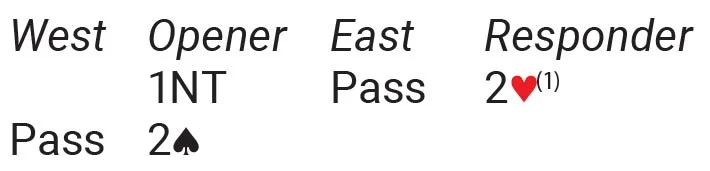
(1) Five or more spades
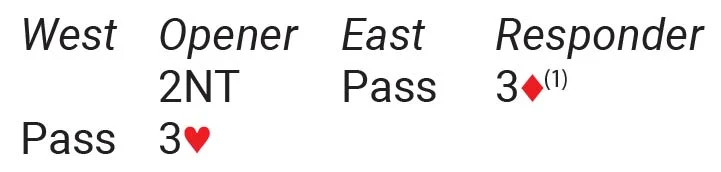
(1) Five or more hearts
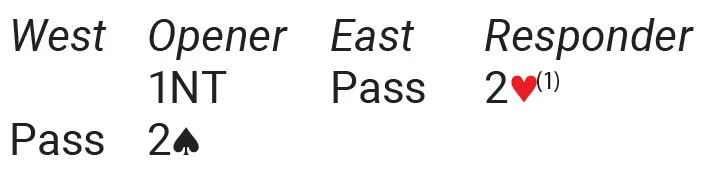
(1) Five or more spades
Why do this?
One reason is that opener, with the strong hand, will become declarer and enjoy the lead coming into their strength, concealing exactly what they hold.
Another advantage is that responder gets another chance to bid. Because responder knows that partner is limited to 15 to 17 high-card points by virtue of opening 1NT (or 20–21 for 2NT), they are now the “captain” of the auction. Responder can pass, ending the auction, or explore the options for strain (suit or notrump) and level (partscore, game or slam). Remember, opener might have only two-card support for the major; if responder has a balanced hand, maybe the best contract isn’t in the major but rather in notrump.
Say opener bids 1NT. With this hand:
♠K J 9 5 2 ♥9 8 ♦10 4 2 ♣7 5 2,
responder transfers to spades and passes – there are not enough values for game.
With a little more strength:
♠K J 9 5 2 ♥K 8 ♦Q 10 9 ♣7 5 2,
responder should transfer to spades and offer 2NT, invitational with five spades and less than 10 HCP.
With 10+ HCP, responder knows their side belongs in game, so they offer a choice:
♠K J 9 5 2 ♥K 8 ♦J 10 9 ♣K 5 2.
After transferring to spades, responder bids 3NT to show five spades and enough points to be in game. The notrump opener will decide if they want to be in 3NT or 4♠.
If responder has six spades and an invitational hand, such as:
♠K J 9 5 3 2 ♥K 8 ♦Q 10 ♣7 5 2,
they bid 3♠ after the transfer, showing the sixth spade and invitational values.

Opener will either pass, bid 3NT or 4♠.
