

Declarer Tips
Managing trumps
Have you tried the ACBL Online Community Games for players with fewer than 50 masterpoints? Join us for a fun, casual game followed by a mini-lesson on Zoom – all with players at your skill level! Each week has a new theme for both games and lessons.
Details are here.
If you miss a game or need to come back to refresh your memory, the lessons and a cool, interactive replay feature are also available. Check out the lesson below from the Nov. 30 game:

Bidding commentary: South has a very strong hand, but three-suiters are very difficult to bid after opening 2♦. (South might open 1♦ but fears missing game.) South does not have an obvious rebid, lacking a five-card or longer suit. The strength is there for a 2NT rebid, although the singleton spade argues against that. South chooses 2NT over bidding a four-card suit (because partner will think it shows five!).
Opening lead: ♠K (promising the ♠Q). East plays an encouraging 9, and West continues with a low spade.
Planning the play: Declarer counts their tricks: Four trumps in hand, three clubs and one diamond to start. Dummy’s trump holding can be worth one or possibly two tricks as well. Both clubs and diamonds provide the chance for additional tricks. The diamond finesse is an attractive option for developing tricks at first glance. However, declarer can’t conveniently reach dummy. Ruffing a club is possible, but you want to avoid shortening the trumps in both hands.
Remember that you are only in 4♥, you can afford to lose another trick or two. If the opposing trumps are divided 3–2, there is a 100% path to success. If they are 4–1, you will likely need the diamond finesse to work.
After ruffing the second spade, cash the ♥A K. When both opponents follow, the rest is easy. Draw the last trump with the ♥Q. Cash the three top clubs, throwing dummy’s remaining two spades away. Then simply play on diamonds, conceding the king when it doesn’t drop.
You cannot risk taking the finesse by using dummy’s last trump lest the defense cash black-suit winners. This way the defense gets only one spade and one diamond. Dummy remains with a trump to prevent the defense from taking any further tricks.
You can replay Board 7 here.
Bridge Term Breakdown
Quick tricks
Prior to the introduction of the point count (A = 4 points, K = 3, Q =2, J = 1), the favored valuation method was quick tricks. It’s a measure of the defensive prospects of the hand and uses only the two highest cards in each suit. Although the point count has essentially replaced this method, it’s still nice to have some defense when you open the bidding.
Here’s a table:
| Holding | Quick Tricks |
|---|---|
| A–K | 2 |
| A–Q | 1-1/2 |
| A–x | 1 |
| K–Q | 1 |
| K–x | 1/2 |
| Less | 0 |
Many players like to have at least 2-1/2 quick tricks to open the bidding at the one level. The important thing is to adopt a consistent approach to opening bids and discuss this with your partner(s).
Consider these two hands:
♠A K 9 8 6 5 ♥A 5 2 ♦8 3 ♣10 4
♠Q J 5 4 ♥K J 6 ♦K 10 5 ♣Q 6 4
Which one do you like better?
Using the table above, the first hand has only 11 high-card points, but it has 3 quick tricks (the ♠A K and the ♥A). The second hand has 12 HCP but only 1 quick trick (1/2 for the ♥K and 1/2 for the ♦K). The first hand is better because it has greater defensive potential (you have three sure tricks most of the time) and lots of offensive potential if spades are trumps. The second hand is inferior on both of those things.
Intermediate cards are valuable, but they’re not quick tricks. They often need to be promoted if they are unsupported by the top honors. For example, say you hold the Q–J–10–9 of a suit. Unless your partner has an ace or king in that suit, you must knock out those cards before you can promote the 10–9.
From the 2022 Phoenix NABC Daily Bulletin “Just For New Players” section by Vic Quiros.
Best Bidding
More about Jacoby transfers
The November “Deal Me In” started the discussion on Jacoby transfers. This treatment is a useful bidding tool, used in response to an opening bid of 1NT (or even 2NT). When responder has a five-card or longer major and partner opens 1NT, responder bids the suit below their suit, transferring partner into a long major, as follows:
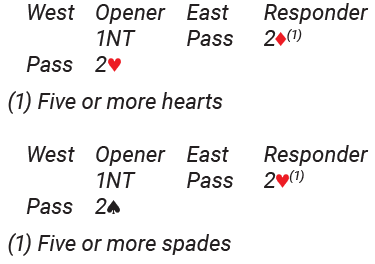
If responder bids again after the opener accepts the transfer, those bids are either invitational or game forcing.
A partnership needs a combined minimum of 25 HCP for a notrump game and a bit more for a major-suit game (or some extra distribution). So, as responder, with partner having 15–17, simply add your high-card points to partner’s (assume 16) and decide what to do. Remember, you could have 0(!) HCP to transfer, so if you bid again, it shows some values.
Your plan as responder following a transfer is this:
With less than invitational values (less than 8 HCP), pass.
With invitational values (a good 8 or 9 HCP), bid 2NT with a five-card major and a balanced hand OR three of your major with a six-card suit. These are the only two invitational bids – they are not forcing, and opener may pass.
With game-forcing strength, a five-card major and a balanced hand (no singletons) bid 3NT. Partner can decide whether to pass or bid 4♥/4♠ based on their hand.
Every other bid as responder following the transfer is therefore forcing and natural, showing a four-card or longer suit and probing for the best game. Once you’ve transferred and bid a second suit naturally, your partner, the notrump opener, knows something about your distribution and that it’s likely you have shortness in the other two suits. Your hand pattern could be any of these:
5–4–2–2
5–4–3–1
5–4–4–0
5–5–2–1
5–5–3–0
The notrump opener can decide what to do: bid 3NT with the other two suits well-controlled or make a bid in support of either of responder’s suits.
Transfers make it easy for opener to know what to do!
