
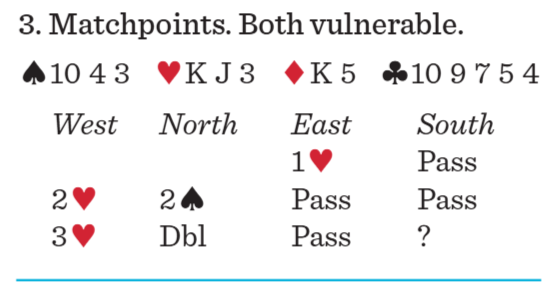
What’s your call?
| 3♠ | 3NT | |||
| 4♣ | 4♦ | 4♥ | 4♠ | 4NT |
| 5♣ | 5♦ | 5♥ | 5♠ | 5NT |
| 6♣ | 6♦ | 6♥ | 6♠ | 6NT |
| 7♣ | 7♦ | 7♥ | 7♠ | 7NT |
| Pass |

Donn jumps to 4♠. “Picture partner with:
♠A K x x x x ♥x ♦A x x ♣A x x.
I probably don’t even need 2–2 spades because I am likely to get a club discard on a heart. That scenario would probably make game for us even if partner’s spades are K–Q–J–x–x–x.”
Sanborn’s rationale for 4♠: “The ♥K is still a probable trick for us, so I feel worth the jump, what with a ruffing value as well.”
Robinson’s 4♠: “Partner’s double says that his 2♠ overcall is serious.”
“Some of what I have may be useful,” says Rigal, who bids 4♠. “I can see the case for passing and hoping to get 200. But if partner has:
♠A K x x x x ♥x ♦Q x x ♣K Q x
or the like, we may be on 2–2 trumps. And that is the minimum for what I expect.”
Korbel, 4♠: “It sounds like partner has something resembling 6–1–3–3 with a good hand; my heart values may be wasted or they may provide a club discard. Bidding 3♠ here would be more consistent with: ♠x x x ♥x x x ♦x x ♣Q x x x x.”
Lee jumps to 4♠. “In this spot, partner must either have six spades or five spades and an exceptional hand, so I will choose to be a bit optimistic.”
The failure to raise to 3♠ last round – a bid the director was taken to task for not making – opens another window now, and that is defending 3♥ doubled.
Quarterback Meckstroth cocks his arm. “Pass! Going for the touchdown!”
Colchamiro explains: “Pass, hoping for a fortunate lie of the hearts for us and that we ring the bell. If I have to, I’ll bust out the ♦K (not on lead) to get my ruff if dummy’s hearts include the ace or queen. It’s not as if 3♠ is a lock for us to go plus.”
“Pass,” suggests Cohen. “I don’t like to take top–bottom actions, but I really expect to set this. Would I lead the ♦K? You didn’t ask, so I don’t have to tell.”
Hampson passes. “I have the wrong values for 4♠ to have a good shot, and I do have a good chance to defeat them two, so I will take it.”
Weinstein opts to defend. “If partner has five spades, pass is clear, and if he has six, it’s close. Plus 200 is too enticing.”
Lawrence: “Pass. If partner has the ♦A, we have four winners. Only need one more for plus 200. If I pull the double to spades, there is the question of how many. My guess is that passing will net about 370 on average, and that will beat all the pairs that fail to bid game or the pairs that go down in game.”
3♠ by Boehm, “what I would have bid a round earlier. I’ve found Reese’s maxim valuable: Don’t double for penalty until you have bid to your own contract.”
Shi bids 3♠. “When partner doubles here, he wants me to bid, not pass. With three-card support, I would need to have a huge trump stack and K–J–x isn’t cutting it. 4♠ is a consideration, but I’m not going to bury my partner at matchpoints.”
Henneberger also goes low with 3♠. “If the ♥K J were elsewhere, I would consider bidding more. It is important to give partner some rope here and allow them to compete with:
♠A K x x x ♥x ♦Q J x ♣K Q J x
or similar hand types.”
