
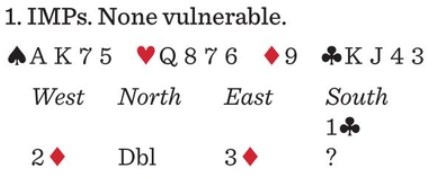
What’s your call?
| 3♥ | 3♠ | 3NT | ||
| 4♣ | 4♦ | 4♥ | 4♠ | 4NT |
| 5♣ | 5♦ | 5♥ | 5♠ | 5NT |
| 6♣ | 6♦ | 6♥ | 6♠ | 6NT |
| 7♣ | 7♦ | 7♥ | 7♠ | 7NT |
| Pass | Dbl |
Constructive bidding emphasizes two elements: (1) strain – do we want to play in clubs, diamonds, hearts, spades or notrump? and (2) level – how high?
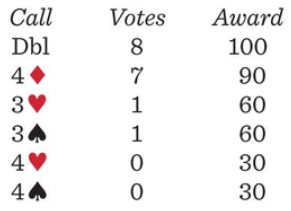
The panelists make strain the first priority, and they’re split on how they approach their investigation.
Sanborn explains double: “Modern usage is not to double for penalty in front of the bidder, so here it should be takeout. It’s always frustrating to guess a major and guess wrong.”
Boehm has double doubt. “It’s ideal if double shows this hand type, but the Do Something Intelligent school would double to show extra values with all sorts of distributions. Maybe we’ll survive.”
Robinson doubles. “When the opponents have bid and raised, double should be takeout-ish.”
Lee: “Looks like a textbook responsive double to me.”
It looks like that to the Sutherlins, too. “Best to use a responsive double, as partner might be 4–3 in the majors.”
Hampson: “I want to get to a real major fit, so I will get partner to choose.”
Falk goes into more detail. “Isn’t this why the responsive double was invented? I’m not worth a 4♦ cuebid, and I don’t want to guess which major suit to bid. A responsive double does not deny a four-card major, but if one has a four-card major, then one has extras – which I do.”
Lawrence agrees: “Takeout. Not 4♦ – too weak to cuebid.”
Others, though, like the unambiguous 4♦ cuebid to uncover the majorsuit fit.
Weinstein’s one. “I want to get to game and to the right strain. I hope partner doesn’t take me too seriously. I’m worried that if I double and then pull 3NT to 4♦ , partner will take me very seriously.”
4♦ by Korbel. “I think I have enough to get to game, and partner doesn’t promise both majors. Even if game is a little light, we might just get lucky and make it.”
Meckstroth on 4♦ : “I am willing to risk game to get to our best fit.”
Colchamiro, 4♦ : “Although the strict value of this hand is at the three level, I’d rather invest a level with 4♦ than show extra values but maybe a doubleton or tripleton diamond with a responsive double. That would risk partner thinking I have more defensive strength than I have and passing. Besides, the opponents might take the bait and save over partner’s 4♥ or 4♠, which I’ll gladly double. Pass, 3♥ or 3♠ = boo for me.”
Stack is a 4♦ bidder. “Although double should be responsive, it would not be easy to know what to do if partner made a minimum bid. Taking the high road may pay off well with either a making game or a sacrifice by the opponents.”
Pavlicek admits his 4♦ is slightly aggressive, “but the priority is to find the right major, not stop on a dime.”
Meyers clarifies her 4♦ . “I think I have enough to bid game, so although 4♦ is a slight overbid, three of a major is, to me, an underbid.”
Two panelists take a swing at guessing the major.
Rigal opts for 3♥. “I think this gives partner room to bid 3♠ if he has doubled with an offshape hand, whereas the reverse does not apply. If we bid 3♠, partner may not be happy to risk going to the four level. Double of 3♦ rates to be strong with no four-card major – just clubs or 18–19 unsuitable for notrump.”
Cohen chooses 3♠. “I see no need to bury partner by driving to game. He can have something like:
♠J x x x ♥K x x x ♦ K x ♣A x x.
That’s actually a decent hand and game is very bad. I bid spades first so that I can bid hearts next if he doesn’t support spades.”
