

What’s your call?
| 1NT | ||||
| 2♣ | 2♦ | 2♥ | 2♠ | 2NT |
| 3♣ | 3♦ | 3♥ | 3♠ | 3NT |
| 4♣ | 4♦ | 4♥ | 4♠ | 4NT |
| 5♣ | 5♦ | 5♥ | 5♠ | 5NT |
| 6♣ | 6♦ | 6♥ | 6♠ | 6NT |
| 7♣ | 7♦ | 7♥ | 7♠ | 7NT |
| Pass |
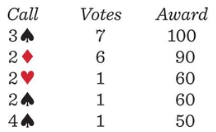
A number of panelists suggest they would have overcalled 1♥ rather than doubling the first time around. But we imposed a double and now look! Partner bid spades. What next?
Falk bids 3♠. “The fact that I do not really know what to do over 1♠ by partner is a strong indication that my original action may not have been optimal. It is certainly possible that partner has only three spades with a weak hand. But having started down this road hoping to hear a spade re- sponse from partner, I have to assume I did the right thing earlier and bid the value of my hand. A cuebid will be of no use here. With a weak hand, partner will rebid 2♠, which does not promise an extra spade or an extra anything, so that is a waste of time. Then bidding 3♠ over 2♠ is forcing, so that is a pointless exercise, trying to pass the blame to partner when the mess is entirely my own.”
3♠ by Lee. “It could be right to play in hearts, but spades is usually at least as good, and an invitation feels right on values with such a soft spade holding.”
Lawrence bids 3♠, catering to a hopeless hand. “Partner will continue with a smattering of cards. If he has five spades, he will continue unless his hand is absolutely awful. Other bids don’t get the job done. A cuebid, for example, will sound to partner as if I have a good hand with three spades.”
Meyers steps into her Goldilocks shoes. “I have too much to bid 2♠, but not enough for 4♠, although that is tempting. 3♠ shows this kind of hand.”
Hampson, 3♠. “We may not have a real spade fit, but anything else that I do will leave the waters muddy.”
Enter the cuebidders.
Weinstein is one, but he says it’s because we made him double on the first round of bidding rather than letting him overcall 1♥. “Now that I am here … This cuebid is usually a good hand with three spades. I am bidding 2♦ even though I have an extra spade, hoping to hear 2♥ from partner. If partner has a 3=2=5=3 yarborough, that’s bad!”
Stack is another cuebidder. “2♦ . It is tempting to bid 2♠ or 4♠ or even some number of hearts, but any of these could be wrong. So let’s start with a cuebid and the hope of finding out more about partner’s hand. It is never our intention to torture partner, but we are sure this bid will do it. Partner doesn’t even necessarily have four spades if he’s 3=2=5=3 with 0–5 HCP.”
Sanborn, “2♦ . I’m close to just bidding 4♠, but so many controls and potential tricks force my action.”
Meckstroth: “2♦ . I have a big hand for partner.”
The Sutherlins: “We intend to push hard with this hand. We start with a cuebid. Perhaps partner will surprise us with his next bid and we can explore for slam.”
Cohen bids 2♥, choosing to ignore spades for the moment. “On some days, partner has only three spades:
♠Q x x ♥x x ♦ x x x x x ♣x x x.
So let me get my good suit into play.”
Bold Barry disappears, and in his place is meek Barry. “I’ll go low with 2♠ which, in my books in a noncompetitive auction, shows 16–18 and four spades. I can stand to miss the occasional game, but not to play 4♠ doubled on a 4–3 fit facing a yarborough.”
Robinson, on the other hand, is fearless. “4♠. Partner needs very little to make game.”
