
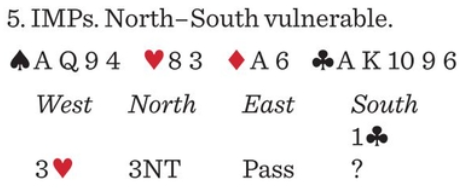
What’s your call?
| 4♣ | 4♦ | 4♥ | 4♠ | 4NT |
| 5♣ | 5♦ | 5♥ | 5♠ | 5NT |
| 6♣ | 6♦ | 6♥ | 6♠ | 6NT |
| 7♣ | 7♦ | 7♥ | 7♠ | 7NT |
| Pass |
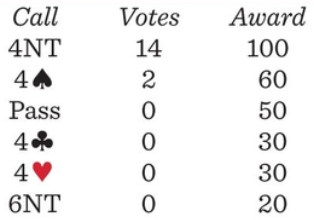
This problem turned out to be a bit of a dud, given the panel’s oh-so-close unanimity. Look at the array of choices, each poorer than the call above it, and yet no takers. Disappointing.
Stack explains the overwhelming popularity of 4NT. “It is easy to pass and say that we do not wish to hang partner, who may have been under pressure to bid. It is also possible that partner had plenty in reserve for the 3NT call. It doesn’t seem possible that we could be in jeopardy in 4NT, so we will show our extra values by bidding the non-forcing 4NT, asking partner to clarify the strength of his 3NT bid.”
Sanborn takes the auction a little further. “Partner is under pressure here and can have a minimum opening or a good hand. I must cater to either, but will tread lightly. It’s possible we can slide back to a suit at the six level. Give partner something like:
♠K x x x ♥A Q ♦ K Q J x x ♣ x x,
and he should bid 5NT over 4NT, looking for a suit contract. The bidding could then proceed 6♣–6♦ –6♠. Note that this hand could have made a negative double, but that might have lost 3NT, so 3NT is the practical bid.”
Lee: “4♠ would sound like I’m more interested in spades or clubs than I am, and I have too much to pass, so a quantitative 4NT invite looks straight to the point.”
Weinstein: “Partner’s 3NT has a wide range – from a marginal game force up to some 18s. If he were stronger, he’d have bid 4NT. With 2NT-rebid strength, I need to invite opposite that range.”
Lawrence adds: “Because the blacksuit finesses will tend to work, this hand is worth more than its point count. It has two good suits, which add more. This hand might be worth more than 4NT, but because North’s lower range is 11 points, I’ll stick with 4NT.”
Hampson, 4NT: “While I would like to indicate extra club length, I am concerned that partner will expect a shapely hand for 4♣, so I will make the value bid for my hand.”
4NT by Meckstroth. “Try for slam, but let partner out.”
Colchamiro: “Every time these hand types come up, it turns out that opening an imperfect 1NT would have left us better placed. Haven’t we learned yet?”
Note how tenderly Rigal is treating his partners this set. “4NT. Partner was under huge pressure to bid. His hand could be something like:
♠J x x ♥Q J x ♦ K Q x x x ♣Q x.
Had partner jumped to 3NT over 2♥, I’d offer a choice of slams. But here, I’m prepared to ‘do as you would be done by.’ I’m sure Rabbi Hillel would have approved, while chalking up minus 13 IMPs on his personal scorecard.” (The Rabbi’s motto was “What is hateful to you, do not do unto others.”)
There are two 4♠ bidders.
Robinson, of course, has yet to meet even a hint of a major he didn’t like (see Problems 2 and 3). “If partner has a heart stopper, he’ll bid 3NT on lots of hands where 3NT is bad.”
And Cohen: “I have just a bit too much to pass. I hope partner doesn’t expect 11 black cards. I think 4NT would more likely be 18–19 balanced, whereas 4♠ better shows the suit nature of the hand. This will give partner a clue to bid 6♣ with, say:
♠K x ♥A J x ♦ K x x x ♣Q x x x.”
