
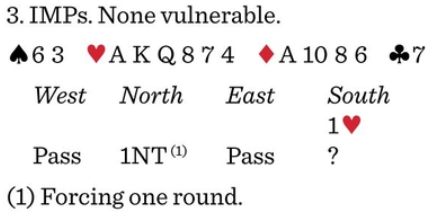
What’s your call?
| 2♣ | 2♦ | 2♥ | 2♠ | 2NT |
| 3♣ | 3♦ | 3♥ | 3♠ | 3NT |
| 4♣ | 4♦ | 4♥ | 4♠ | 4NT |
| 5♣ | 5♦ | 5♥ | 5♠ | 5NT |
| 6♣ | 6♦ | 6♥ | 6♠ | 6NT |
| 7♣ | 7♦ | 7♥ | 7♠ | 7NT |
| Pass |
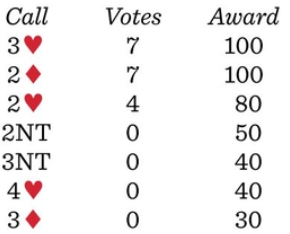
3♥ by Lawrence, “direct and simple.” Boehm: “Eight-winner hand is too good for 2♥, although 2♦ sometimes works better.”
Lee: “3♥. Bit of an overbid, but 2♥ is just as big of an underbid. I normally bid my side four-card suit in this situation, but here the hearts are good enough that I’ll just hide my hand.”
Meyers: “My good hearts and 6–4 distribution make this a good 3♥ bid.”
Colchamiro: “Usually I bid my second suit, but here, because of the quality of the heart suit, 3♥ is the shortest, most direct route to game.”
Robinson, 3♥: “Partner needs very little to make game, and my hearts can play opposite a singleton. Make my hand:
♠x x ♥A x x x x x ♦ A K Q x ♣x,
and I’d bid 2♦ .”
Korbel prefers 2♦ . “I feel this hand is strong enough to show partner my side suit, and if the auction doesn’t end, raise 2♥ to 3♥. He will value outside prime cards and diamond honors – exactly what this hand needs.”
Sanborn, too: “It is normal to bid a good 6–4 pattern by bidding the minor over 1NT, then rebidding the major next round. With a weak hand, bid the major.”
Stack calls the hand close, but not quite enough for 3♥, making 2♦ and 2♥ his alternatives. “I bid 2♦ . A 2♥ rebid is more likely to end the auction than 2♦ . If we can get partner to bid over 2♦ , then we can follow up with 3♥.”
Cohen blames his 2♦ on poor, innocent David Berkowitz, who isn’t here to defend himself. “He always showed the four-card suit and convinced me it is usually right. I can show at least nine of my cards this way, instead of only six. If I get another chance, I can bid hearts and complete a nice picture. If I don’t get 100 points, I blame him.”
Weinstein, trusting soul that he is, bids 2♦ . “My hand is good enough that I’m OK bidding 3♥ next over anything partner bids, and partner knows enough about my hand to get it right. If partner passes 2♦ , that’s fine, too.”
Falk goes with 2♦ . “I understand that 3♥ could be the winning action, but if partner is going to pass 2♦ , 3♥ could be pretty hopeless. With most heart doubletons, North will take me back to 2♥ and I can then bid 3♥, showing my 6–4. If I bid 3♥, North will raise me to game with black-suit values, having no idea they may be worthless. The opponents’ silence actually does suggest that partner has values in the black suits. Also, 5♦ could be right opposite:
♠A x x ♥— ♦ x x x x x x ♣J x x x.”
Ditto Handley: “2♥ makes it tough to get to diamonds if diamonds is the right trump suit. Why can’t partner have the ♠A and ♦ K Q x x x? If partner passes 2♦ , I will expect a plus score, and if partner has the right hand to pass 2♦ , 4♥ is unlikely to be a good contract.”
The rest of the panel is content with 2♥.
Rigal: “It’s hard to see how we will miss game if partner has an invite. And if he doesn’t, maybe hearts will play better than diamonds facing a hand that is 1–3 in the red suits. Make the ♥Q the ♦ Q and I bid 2♦ for sure.”
Meckstroth rebids 2♥. “With stronger diamonds and weaker hearts, I might bid 2♦ .”
Hampson’s 2♥: “My texture is wrong to try and start with 2♦ and I think 3♥ is too much.”
2♥ by the Sutherlins: “4♥ is our most likely game. 2♥ describes our hand well and gives us our best chance to reach 4♥. If partner raises or bids 2NT, we will bid 4♥. If we bid 2♦ and partner corrects to 2♥, we have no good rebid.”
