
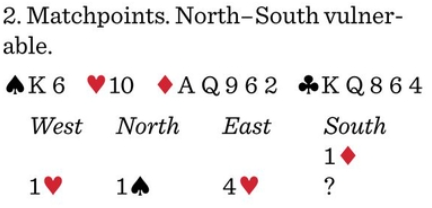
What’s your call?
| 4♠ | 4NT | |||
| 5♣ | 5♦ | 5♥ | 5♠ | 5NT |
| 6♣ | 6♦ | 6♥ | 6♠ | 6NT |
| 7♣ | 7♦ | 7♥ | 7♠ | 7NT |
| Pass | Dbl |

The panel is split right down the middle, or at least as evenly as a bunch of odd people can be split: pass or lurch onward in search of … ?
Kennedy’s rationale is simplicity itself. “Pass. After all, I have only a minimum opening bid and a misfit with partner.”
Pass by Meckstroth. “Can’t bid here. Partner still has a call left.”
Sanborn: “Pass. I always want to bid, but I can’t demand the five level with these suits.”
Boehm emphasizes the importance of passing in tempo. “I might double with the majors reversed. Inexperienced players often break tempo – naturally enough in this awkward situation – but then they may as well bid 5♣, a significant overbid. Experi ence is a good teacher.”
Rigal passes. “I won’t sit for 4♥ doubled – maybe I’ll try 4NT for the minors. There’s no good answer, but a direct 5♣ is just too much for a wimp like me.”
And Robinson: “Partner doesn’t promise the world for his 1♠ call. If I bid 5♣, I might find him with 6=3=2=2 distribution. I have a minimum opener, and pass allows him to describe his hand. The problem comes if partner doubles 4♥.”
Ditto Stack: “Usually I take the bullish approach, but I have already opened the bidding showing values, and the idea of putting this vulnerable hand on the five level when partner has a bid coming does not appeal.”
“So I’ve got a club extra,” says Falk, waving the green card. “Big deal. That hardly warrants guessing to now bid 5♣ or anything else. Partner is unlimited: Perhaps he has nothing much and will pass; possibly he has a middling hand with an extra spade or two and will bid 4♠, or maybe he’s got enough to double (I think I’ll convert to 5♣ so he can pick a minor-suit game). Partner knows his hand and I don’t, so I won’t try to bid it for him.”
Handley passes. “Anything else is too unilateral. I would not be unhappy to hear partner bid 4♠. 5♣ by me now might get us above our only making game. I’d double if my majors were reversed.”
Colchamiro looks in his hand and finds extras (“barely”), so he doubles.
Double by the Sutherlins: “We have extra strength and distribution, including moderate support in spades. Let’s hear from partner. Perhaps he has a six-card spade suit, perhaps even longer, and he will be able to bid spades again.”
Double by the easygoing Weinstein: “A little light, but everything seems to be working, and I’m not too upset with anything partner does over the double. But if I pass and partner doubles, I’m not sure what to do, so why should I be tortured when I can torture him?”
Hampson uses double as an asking bid. “I have a good playing hand for the bidding so far and I don’t know what to bid, so I will see if partner has an opinion.”
Korbel says nobody plays double as penalty anymore. “Partner will play me for a flexible hand. Although it will be hard to find a club fit, getting to 4♠ will be even harder if I bid 5♣ now.”
Lee doubles to show a good hand with no clear direction. “It’s a mild overbid, but I’m not going to pass or commit us to five of a minor.”
In inimitable Mike Lawrence fashion, Lawrence lays out les bids du jour and concludes, “Nothing to feel good about here. Pass, 4♠, double and 5♣ are all possible, not necessarily in that order. I have a liking for 4♠ because (1) if partner has decent spades, it may be our only game; (2) the vulnerability is right for the opponents to save, and (3) it’s the cheapest available game. But a lot can go wrong with 4♠, too. Glad it’s matchpoints.
From Lawrence’s menu, Cohen selects 5♣. “I am persuaded by my singleton heart and fitting ♠K.”
Meyers orders off-menu. “I would bid 4NT, which I think should be interpreted as both minors unless I correct to 5♠, which I play with most partners as a slam try in spades.”
