

What’s your call?
| 5♥ | 5♠ | 5NT | ||
| 6♣ | 6♦ | 6♥ | 6♠ | 6NT |
| 7♣ | 7♦ | 7♥ | 7♠ | 7NT |
| Pass | Dbl |
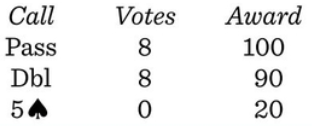
Opponents’ preempts are designed to drive you a little mad, as a few of the panelists prove.
Cohen passes. “I liked bridge better in 1980 when the opponents left us alone.”
A straightforward pass from Meckstroth. “Not enough defense to double.”
Pass by Weinstein, too, who gets somewhat sidetracked: “Who are these crazy people that don’t play Flannery?”
“Pass seems meek,” says Lee, “but I don’t have any reason to think we can make anything, or that they are down.”
Rigal offers this fortune-cookie philosophy justifying his pass: “It is easy to be a paper tiger; it is much harder to admit to being a coward on paper. I’m not sure we can beat 5♦ and I do not fancy doubling and hearing 5♥. Once in a while, our only plus or smallest minus might be defending 5♦ .”
Hampson, noting that partner already rejected a chance to act at the two level, passes. “I am not strong enough to bid at the five level.”
“Not enough to get involved,” surmise the Sutherlins. “East may have a good hand. Bidding could easily result in minus 800 or 1100.”
Colchamiro is totally flipping out. “If I am the underdog, I double; if I am an overdog, I pass. If I am an evendog, I flip a coin five times – which is what I did. Heads means I double, tails means I pass. It came up tails on the fifth flip, so I pass. 5♠ is not for me.”
“I am not passing,” warns Meyers, waving the red double card. “I think partner’s most likely bid over my double will be pass. He won’t pull unless he has a one- or two-suited hand. When I correct 5♥ to 5♠, partner should suspect I have clubs and spades.”
Lawrence doubles after examining his options. “This is a typical headache. I can pass. Or I can double and risk partner bidding 5♥. Double is takeoutish in theory: ‘Guess which suit to bid.’ Both calls are dangerous. Because it’s matchpoints, I will double. But it’s ugly.”
A paranoid Stack doubles. “The auction screams that they are trying to steal from us. Or are they? This hand is worth a bid, even if they end up making 5♦ doubled. If partner pulls to 5♥, we will bid 5♠, suggesting that clubs are also in the picture. I cannot pass with this good a hand.”
“Double,” announces Robinson. “When you think they’re stealing, you have to double. Usually partner will pass the double. Partner should pull only to show a long suit.”
Sanborn doubles. “Then I will guess over 5♥ … probably I’ll bid 5♠. There are too many hands where it is our game, so I feel like I have to protect.”
Apparently someone took all of the green cards out of Falk’s bidding box, because he contemplates several calls – none of which is pass – before he doubles. “If partner is broke, I’ll probably end up minus 550 or 650 or 750 – not good, but not a disaster. If I bid and partner is broke, I’m going for my life – in the range of minus 800–1700. And I don’t feel like guessing whether to stab at 5♠ or 6♣. Hopefully partner, knowing I am under tremendous pressure, will do the right thing.
Boehm’s a doubler. “These highlevel doubles are usually left in unless advancer is very unbalanced (read that any way you want).”
