
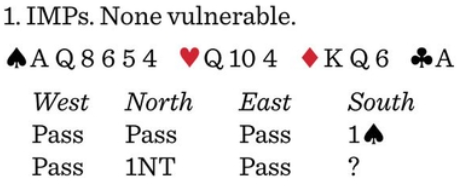
What’s your call?
| 2♣ | 2♦ | 2♥ | 2♠ | 2NT |
| 3♣ | 3♦ | 3♥ | 3♠ | 3NT |
| 4♣ | 4♦ | 4♥ | 4♠ | 4NT |
| 5♣ | 5♦ | 5♥ | 5♠ | 5NT |
| 6♣ | 6♦ | 6♥ | 6♠ | 6NT |
| 7♣ | 7♦ | 7♥ | 7♠ | 7NT |
| Pass |
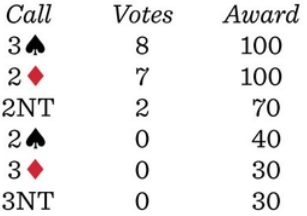
Let’s lead off with the guest of honor. 3♠ by Handley. “It’s right on values. We – like the rest of the world – wish the spade spots were better. My second choice would be 2NT, which would at least give us a chance to get to hearts if that is the right trump suit.”
3♠ says Boehm. “Plain, not fancy.”
Kennedy: “3♠. Pretty classic.”
Meckstroth: “3♠. Straightforward.”
Korbel calls inventing a 2♦ rebid “superficially attractive,” but prefers 3♠. “If partner has a good hand with a singleton spade, he will sometimes try 3NT, which we will be happy to pass. If he has two or more spades, we will play in the normal spade contract. I would hate to end up in 2♦ opposite something like:
♠x ♥K J x x x ♦ J x x ♣K x x x.”
Stack says 3♠ is right for many reasons. “The suit length and high-card points conform to what’s expected.”
The Sutherlins call 3♠ “a good value description of this hand, although a little light on suit quality. A 2♦ rebid might end the auction when 4♠ is a good contract.”
Falk balks. “I’m not bidding 3♠ with such a ratty suit and ratty hand.” His call is 2♦ . “I can show extras later if it seems appropriate. I’m not raising notrump with a singleton ace.”
Waving the 2♦ card, Lawrence expounds, “There is no satisfactory ‘normal’ bid at this point. 2♠ is an underbid. 3♠ is right on values but the spades are horrible. If you get passed in 3♠, you’re going down. 2NT is a mild overbid by my standards and hides the sixth spade. The single risk with 2♦ is that it will be passed out. How bad will that be? It might be very bad, but if partner passes, he rates to have only one spade. The biggest advantage to 2♦ is if partner bids again. If he bids 2♠, you can bid 3♠, showing this approximate hand. If he bids 2♥, you can raise to game. If he bids 3♦ , you know he has values and can bid 3♠, forcing. The good things after 2♦ outweigh the bad ones.”
2♦ by Sanborn, “preparatory to rebidding spades to show a good hand. Usually it shows 6–4, but it can be this.”
Lee bids 2♦ . “I don’t want to commit to spades right now. This is our best chance to get to either spades, hearts or even diamonds if it’s right.”
2♦ by Robinson, who says, “I’ve had good success bidding three-card minors in this situation. The spades are not good enough to jump to 3♠ and play opposite a possible singleton. 2NT might miss a 6–2 spade fit.”
Colchamiro bids 2♦ , “not because of strength, but to get to the correct contract. My second choice is the inelegant 3♠.”
Meyers dilly-dallies around before landing on 2♦ . “I wish I were playing Gazilli on this hand (2♣, artificial and forcing, shows a sound opener, at least 17 HCP). I don’t have enough suit quality to bid 3♠. 2NT is tempting, but the ‘phony’ 2♦ will give me options. If partner bids 2♥ or 2♠, I will raise; if partner passes, we are probably high enough, and if partner raises, I will bid a forcing 3♥.”
Hampson decides on 2NT. “I have a sixth spade, but with scattered assets and weak spades, I feel 2NT is a better description.”
Cohen calls it a toss-up between 2NT and 3♠, and goes with 2NT. “Because the spades are so-so and there are honors in every suit, I’ll call it notrump. I am willing to treat this as an 18–19 count.”
