

What’s your call?
| 3NT | ||||
| 4♣ | 4♦ | 4♥ | 4♠ | 4NT |
| 5♣ | 5♦ | 5♥ | 5♠ | 5NT |
| 6♣ | 6♦ | 6♥ | 6♠ | 6NT |
| 7♣ | 7♦ | 7♥ | 7♠ | 7NT |
| Pass | Dbl |
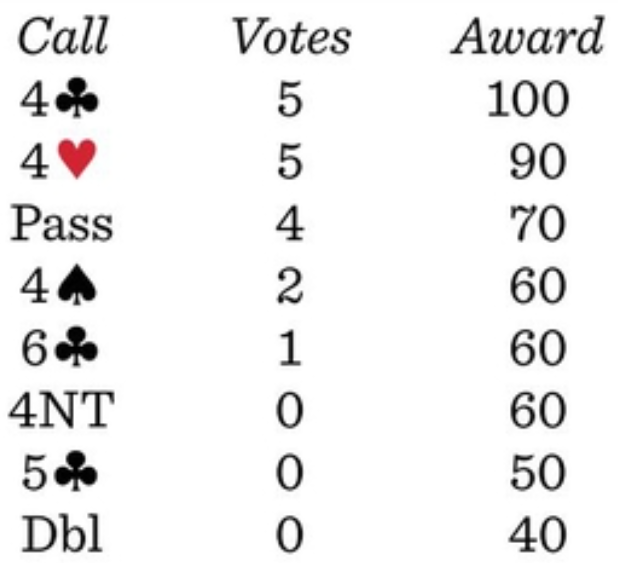
There are all sorts of calls to shop from on this one. The scorer looked more kindly on 4♣ than 4♥ – which tied for the most votes – because 4♣ unequivocally moves forward in clubs. “If some of the 4♥ bidders intended their choice as a cuebid for clubs,” says Walker, “it’s ambiguous at best, as partner will probably take it as natural and may even pass with three hearts.”
Sanborn pulls 4♣ from the rack, which she says “should point out the unbalanced nature of my hand with-out overstating the slam possibilities. There are too many holes for me to take over and go slamming. I could easily be facing:
♠A x ♥K x x ♦ K Q x x ♣J x x x.
Now, even the five level is in jeopardy. Granted, I have great controls, but on this hand, I need some fillers.”
Korbel bids 4♣, secure in the knowledge that because 2♣ is game forcing, partner isn’t going to pass. “We could have a slam opposite:
♠x x ♥K Q x ♦ K x x x ♣A J x x
or go down in 5♣ opposite:
♠K x ♥x x x ♦ K x x x ♣A Q J x.”
4♣ by Weinstein, who isn’t all that worried about playing 5♣ instead of 3NT at IMPs. “I want to try for a slam, and I don’t need much from partner.”
Cohen’s rationale is similar. “I could pass to hear partner’s opinion, but 4♣ doesn’t take up much room expresses my interest in playing a club contract. I was never sitting for a double or 3NT, so I might as well make a move towards the club game/slam.”
Meyers bids 4♥. “Partner could have four hearts on this hand.”
And Falk: “Whatever partner thinks this shows (he will expect at least three hearts and the ace), I feel slammish. I have controls in every suit, an extra club, three key cards. So I’ll solicit North’s input into whether 5♣ or 6♣ is our spot. If we have a heart fit, we probably can’t stop in 4♥ anyway. I don’t have a source of tricks, so I don’t want to bid 4NT – even if 4NT is Blackwood. And if it is, I can’t handle a one key-card reply because it forces us to the six level without telling me anything really useful. 4♦ may leave partner wondering about heart control. 4♥ is clearly slammish noise, whereas 4♦ makes my original 2♣ ambiguous and is not necessarily slammish.”
Stack calls his 4♥ a cuebid and forcing and not a choice of games. “Partner has raised our six-card suit and we are rich in controls. Let’s see if we can induce a 4♠ cuebid, in which case we have an easy 6♣ bid. Is there possibly even a grand slam? Yes, there may be, but how would you get there?”
The Sutherlins let silence carry their message. “Pass. We are in a forcing auction. There is no need to zoom past 3NT. We are probably going to clubs, but partner may be able to bid 3NT with something like ♠A 10 8.”
Hampson passes to hear what partner has to say. “I have a nice playing hand, but I want to hear if partner bids 3NT (bad news), 4♣ (good news) or just doubles (I won’t pass that).”
Pass by Lee. “We are in a force, and I’m happy to hear my partner bid 3NT. If he can’t, we will play 5♣ or a slam”
Absent a 4♦ or 4♥ call, Boehm says his 4♠ “implies both red-suit, first-round controls.”
Rigal calls his 4♠ cue a mild overbid, “but because slam is cold facing the right minimum, e.g.,
♠x x ♥x x x ♦ K Q J x x ♣A Q x,
how could I not make a try? Here I think partner can bid slam but is more likely to try 4NT if he has a decent
6♣ by none other than Mr. Colchamiro, who concedes it’s “a bit inelegant, but I’m bidding what I think I can make. Besides, 4♠ here accomplishes nothing because we have both red aces. And exactly how do we ask for key cards? 4♥? 4NT? I’m not sure, so as I said, I’m bidding what I think I can make.”
So there!
