
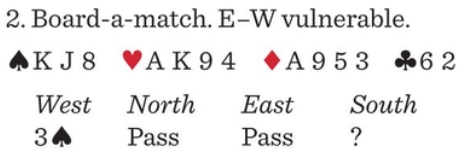
What’s your call?
| 3NT | ||||
| 4♣ | 4♦ | 4♥ | 4♠ | 4NT |
| 5♣ | 5♦ | 5♥ | 5♠ | 5NT |
| 6♣ | 6♦ | 6♥ | 6♠ | 6NT |
| 7♣ | 7♦ | 7♥ | 7♠ | 7NT |
| Pass | Dbl |
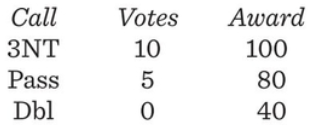
Invoking Bob Hamman’s name is always a popular way to justify 3NT. And it’s hard to argue with a dozen Reisingers.
Cohen: “Blame Hamman if this is wrong. Even minus 50 or minus 100 might be OK if they are making 140. I don’t want to double and be dummy with a spade lead through.”
Meckstroth, with nine Reisingers of his own, bids 3NT.
Lawrence’s name is inscribed on that trophy a number of times. “3NT. The beauty of this form of scoring is that a horrible result is no worse than a poor result.”
Meyers, 3NT: “At IMPs, I would pass.”
Robinson, 3NT: “This is a bidder’s game. Partner is allowed to have a long suit and some points.”
Hampson’s game. “From my side we may scramble nine-plus tricks. If we don’t, it may be a cheap save.”
Rigal chooses 3NT, but he is conflicted. “Of three sensible alternatives – pass, double and 3NT – 3NT is probably slightly the more flexible action. But you can imagine that passing might be our only plus score, and doubling might get us to hearts or diamonds instead of notrump.”
3NT by Falk, too. “I am under strength, but if I can catch as little as:
♠9 ♥J 10 ♦ K x x x x x ♣Q J 10 x,
I can probably make 3NT, even without a spade lead, and I’ll have decent chances if partner has less. Meanwhile, even down two undoubled will beat minus 140. At IMPs or matchpoints, I would expect to go plus 100 most of the time and be unwilling to risk my plus by contracting for nine tricks when I can take only three or four in my own hand, and the risk of playing something doubled will mean a disaster. At BAM, if 3NT is doubled and down six, it’s just one board, and actions like this will win far more often than they will lose.”
Stack bids 3NT. “This is a familiar situation where it is dangerous to bid and dangerous not to bid. We are certainly minimum for the 3NT call, but nobody can take my rose-colored glasses away from me. A big thank-you to Bob Hamman for his famous rule: ‘bid 3NT when it is a reasonable alternative.’ It’s a rule I invoke more than I should.”
3NT by Sanborn, but it doesn’t necessarily end the auction. “We still have a slight chance to get to hearts.”
Lee passes, “a somewhat close decision. But I think we’re much closer to five tricks than nine.”
Korbel says it’s a toss-up between passing and bidding 3NT. “I can probably defeat 3♠, and I have no idea where our tricks will come from in 3NT. So I will just take the money and hope it’s right.”
Colchamiro says that passing looks like the best chance for a plus. “Partner didn’t act, and even if he has a singleton spade, it renders my K–J useless in a heart or diamond contract. If I try 3NT, it’s a crap shoot as to who has the singleton – partner or righty. If I knew the right course of action or had a great sense of what might be the winning contract, I would act. But because I don’t, I won’t.”
Also heeding partner’s silence over 3♠, the Sutherlins pass. “Partner is presumably short in spades and failed to act. Our best chance to win the board is to pass and collect 200 or more.”
Boehm passes. “3NT or double could easily work, but the plus score I expect on defense will win the board if the other table reaches the wrong game or if no game makes.”
