
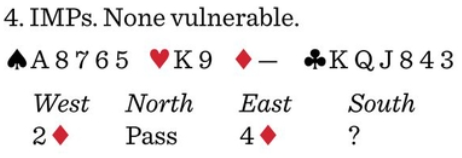
What’s your call?
| 4♥ | 4♠ | 4NT | ||
| 5♣ | 5♦ | 5♥ | 5♠ | 5NT |
| 6♣ | 6♦ | 6♥ | 6♠ | 6NT |
| 7♣ | 7♦ | 7♥ | 7♠ | 7NT |
| Pass | Dbl |
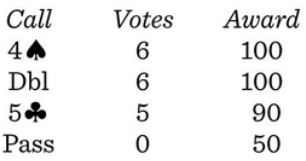
Lee, torn between 4♠ and 5♣, chooses 4♠. “5♣ gives us better chances at slam and could obviously be a much, much better contract than 4♠. But I think 4♠ is the most likely making game, and that takes top priority.”
Rigal mans up: “4♠. Minors are for children.”
Cohen’s 4♠: “I’ll have to gauge how much saliva comes out of East’s mouth if he doubles 4♠, as to my decision to run to 5♣.”
Hampson: “4♠ is our most promising game contract.”
Stack’s 4♠: “I cannot double and correct hearts to spades because this would show a great spade suit and a great hand. If partner has three or more spades, we will be very happy. But if the opponents double, we will possibly put on our running shoes and dash to 5♣.”
Weinstein doubles, and likens shopping for a call to shopping for a new car: “Three good things good happen. “We could defend 4♦ doubled (when it’s right), we could play in spades or we could play in clubs. Anything else limits my options. When you buy a car and they offer you options for free, do you turn them down?”
The Sutherlins start with a double. “If partner bids 4♥, we will convert to 4♠ showing spades and clubs. Better to get both suits in play rather than guessing where partner has length.”
Abdou, Meyers and Robinson have the same plan.
Lawrence’s double “leaves a few more options than a direct punt of 4♠ or 5♣.”
It’s hard to deny the safety of a sixcard suit headed by the K–Q–J.
5♣ by Boehm, “putting faith in the long suit.”
Past experience informs Korbel’s decision to bid 5♣. “Every time I bid my weaker suit on this hand type, it works out badly for me. I will bid my best suit and hope to survive.”
Sanborn opts for 5♣. “I think I’m a pip or two away from 4♠. But 4♠ could be right. Maybe I will get a chance to bid spades on the next round.”
Falk bids 5♣, saying, “4♠ is awfully unilateral on such a moth-eaten suit. It also does not position me for further bidding if there is more competition.”
