

What’s your call?
| 4♥ | 4♠ | 4NT | ||
| 5♣ | 5♦ | 5♥ | 5♠ | 5NT |
| 6♣ | 6♦ | 6♥ | 6♠ | 6NT |
| 7♣ | 7♦ | 7♥ | 7♠ | 7NT |
| Pass |
Republished from “Famous Bidding Decisions” by Terence Reese and David Bird
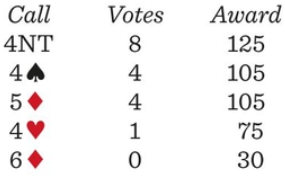
4NT, the consensus call on this problem, is not Blackwood or key card or anything at all forward-going: It’s a big stop sign that says “I had no interest in going beyond 3NT and I still feel that way.”
4NT by Weinstein, who calls this problem “a question of where to bail, not if I should bail. I choose notrump because I can see using hearts, diamonds or clubs for my source of tricks.”
Falk uses 4NT to demonstrate his lack of enthusiasm for proceeding further. “I have only one ace, and it is probably opposite a void.” He samples five different North hands and concludes, “5♦ may not be cold and 6♦ may be anything from good to terrible, with terrible more likely. So I go low and avoid guessing just how partner’s honors are distributed. By the way, I do not think it possible that North has four-card diamond support. With any such hand, I’d have heard a 3♠ splinter on the second round.”
4NT by Boehm, too. “With a lot of spade waste, little in partner’s suits, topless diamonds and a likely trump lead, it’s time to put on the brakes. Even facing:
♠— ♥A K x x x ♦ K x x ♣A K x x x,
slam is no bargain.”
Meckstroth shares that dim view. “4NT. I have a poor hand with too much in spades. 4♠ by me would be positive in diamonds.”
Abdou, too, bids 4NT, citing wasted spade values. “I disagree with the game force on this amorphous 12 count.”
Lee bids 4NT. “I have a lot in spades and a minimum, so I’ll just make a regressive bid.”
Rigal also hits the floor with 4NT. “No controls where they matter and a minimum hand. 4NT seems clear, which generally means I’ll be in a minority of one.”
Ditto Meyers: “Partner is inviting. I don’t have an acceptance.”
On a more positive note, Lawrence says 4♠ feels automatic. “My ♦ 10 may be important if partner has ♦ A x or ♦ K x. Yes, wasted spade cards … but other pluses make up for them.”
4♠ by Korbel, who believes he owes partner one cuebid. “Although I have a lot of values in spades, he could have a hand like:
♠x ♥A K x x x ♦ K x x ♣A K x x
to go past 3NT. If he has a weaker hand, he is unlikely to get us too high on his own.”
Hampson chooses the 4♠cue. “I am borderline for being worth any cooperation, but I will make one noise.”
Stack cooperates. “4♠. The diamond suit is decent and we have an ace and a possible fitting club card, so we will advance with the spade cuebid. If partner does not bid 6♦ after this, then we will be happy with 5♦ and hope we make it.”
The Sutherlins explain the benefits of 5♦ : “We have a minimum 2♦ bid, which has now shrunk in value because of wasted spade values. It is unlikely that partner has two low spades and is looking for a spade cuebid, particularly after we have shown a spade stopper with 3NT.”
5♦ by the world-class Cohen, who, despite his many years of experience, suggests bidding backwards. “I’d like to bid 3NT again, but I suppose you won’t let me. At matchpoints, I’d be more inclined to try 4♥. I don’t like my hand enough to control-bid the ♠A. Unless partner can drive to slam on his own, I don’t want to be there.”
Colchamiro started out a 4NT believer, then made the switch to 5♦ . “Opposite, say,
♠— ♥A K x x x ♦ K x x ♣K x x x x,
4NT will struggle and 5♦ , while not a lock, seems to be a better bet. If partner has more and bids six, we’ll have chances. The ♦ 10 may well be the key card of the hand.”
5♦ by Robinson: “Shows a minimum with spade wastage.”
Sanborn bids 4♥. “I have nothing extra to say. I have no reason to think I can do better in notrump, even though I have extra stoppers in the pointed suits.”
