
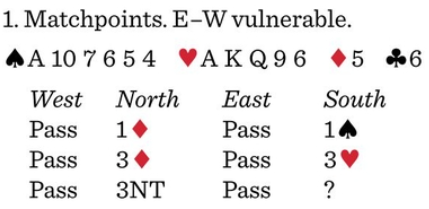
What’s your call?
| 4♣ | 4♦ | 4♥ | 4♠ | 4NT |
| 5♣ | 5♦ | 5♥ | 5♠ | 5NT |
| 6♣ | 6♦ | 6♥ | 6♠ | 6NT |
| 7♣ | 7♦ | 7♥ | 7♠ | 7NT |
| Pass |
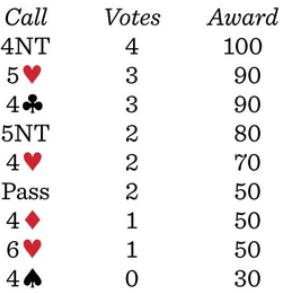
This problem may have set a record for the number of different calls by the panelists, a reminder that bridge is not a black-or-white proposition.
Colchamiro bids a quantitative 4NT after flirting with a couple of other calls first. “Pass is my second choice. At first I thought that the obvious 4♥would be my conservative choice, but opposite so many North hands that contain a one-loser diamond suit (as is likely) plus the ♣A, slam is highly likely. So I’ll give him one poke.”
Stack also moves forward with 4NT. “While this is positive, it is not forcing. This hand is surely worth at least that. On a bullish day, wearing rose-colored glasses, we might bid 5NT ‘pick-a-slam.’ It would be nice to bid 4♥ if that would show this strength, but 4♥ just says, ‘take your choice.’”
Rigal describes his 5♥ as “not perfect, but a decent way to get this two-suiter across. I will accept the conversion to 6♦ and will pass 5♠ more in hope than expectation. Looking for6♥ facing:
♠x ♥x x x ♦ A K Q x x x ♣A Q x.
On a club lead, I cross-ruff. On anyother lead, I draw trumps and try to setup diamonds.”
Guest panelist Handley chooses “the most natural, strength-showing bid” she can make: 5♥. “The controls are too good to bid just 4♥. If partner’s diamonds are solid, the hand has to be cold for at least 12 tricks. And if they aren’t, hearts may be our best trump suit.”
Weinstein bids a forcing, though otherwise meaningless, 4♣ to keep the ball in the air. “I’m not willing to force to slam or pass 3NT, so I’ll make a general force and see what partner does.”
Meckstroth selects 4♣. “I’m not ready to give up on slam yet. We might want to be in 6♦ .”
Lee, too, likes 4♣. “I could bid 4♦ to show diamonds, so I think this is just a generally forward-going, good hand without a diamond fit.”
“What a hard hand!” exclaims Sanborn. She bids 5NT. “My gut is that 6♦ is the right spot, but in case partner’s diamonds are not solid (and I haven’t raised them), we still have a chance to play the 5–3 heart fit. The contract I would be most afraid of is 6♠ facing ♠Q x or ♠J x. I might have to reevaluate if I hear 6♠ – maybe pull to 6NT.”
5NT is Lawrence’s stalling tactic. “Not easy. Slam is likely, but not guaranteed at all. If there is a slam, it’s probably in hearts or diamonds. Or even notrump. 4♥ wouldn’t be forcing, so if I am looking for slam, it will be something of a grope. If I had two diamonds, I would bid 4♦ . As it is, I bid 5NT, asking partner to pick a slam.”
Cohen crashes the happy party. “4♥.With a probable misfit, I don’t wish todo anything more slammish.”
Hampson: “4♥. 3♥ might have been perceived as an attempt to get to 3NT facing a club stopper. I still need toconvey that I have big majors.”
Kennedy passes pessimistically. “This is clearly a misfit and we haven’t been doubled yet.”
Robinson passes, too. “I have enough to make a forward-going call, but what should I bid? 4♦ on a singleton? 4♥? I’m not sure that’s forcing and partner might not have three hearts. Pass has the advantage of going plus.”
Meyers bids 4♦ , trusting the suit quality and length she hopes partner showed with 3♦ . “My hand is too strong to not make a forcing call. I have a lot of high-card points in the majors, and to jump to 3♦ , partner has to have a good suit. We could easily have a slam.”
The Sutherlins give partner a choice of majors at the six level. “6♥. The only forcing bid we can make is 4♣. This is likely to lead to confusion. We think this hand is a favorite to make six of a major, so we take a shot with 6♥. If partner is short in both majors, he can convert to 6NT.”
