
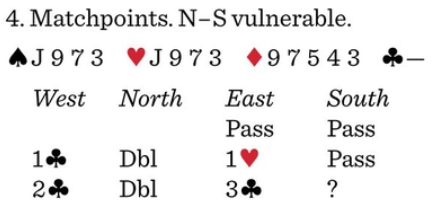
What’s your call?
| 3♦ | 3♥ | 3♠ | 3NT | |
| 4♣ | 4♦ | 4♥ | 4♠ | 4NT |
| 5♣ | 5♦ | 5♥ | 5♠ | 5NT |
| 6♣ | 6♦ | 6♥ | 6♠ | 6NT |
| 7♣ | 7♦ | 7♥ | 7♠ | 7NT |
| Pass | Dbl |
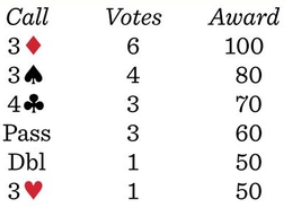
Meckstroth takes the straight-forward route. “3♦ . I want to play in my best fit here.”
Lee can’t bring himself to pass with a club void. “3♦ . It could be ugly. We just rate to have a better diamond fit than spade fit.”
Sanborn, 3♦ : “Even if we have an eight-card spade fit, a heart lead could scuttle that contract – needing to ruff clubs and run diamonds later. Would I pass here? Only because I couldn’t figure out which suit to bid. I’m sure we have a better score in 3♦ than defending 3♣.”
Falk bids 3♦ , despite the strong attraction of 3♠. “Partner just has a really good hand. Because I have a club void, he is a favorite to have at least two, so he could have any of a number of flat hands with 19-plus HCP. The only thing of which I can be certain is that diamonds is a fit of some sort.”
Cohen: 3♦ . “Surely I want to compete with my great shape, so it is just a question of this or 3♠. Maybe buying it and making any contract will score well, so I won’t greedily try for the home run in the major.”
Handley gets sucked into the MP trap. “3♠. Too much shape to pass, and spades score better than diamonds at matchpoints.”
Hampson is also a 3♠ bidder. “I won’t keep silent, and no action is clear, so I opt for the most rewarding suit.”
Then there are the always-intrepid cuebidders. Here, there’s no chance partner will play them for anything in the way of high-card points.
Korbel explains. “4♣ should imply two places to play and a weak, shapely hand. Partner should be able to infer that I have spades and diamonds.”
Colchamiro’s 4♣: “I’m game for whatever partner wants.”
Robinson: “4♣. At least I’ll get to the best strain. Partner doesn’t promise four spades, and if partner has good diamonds, 4♦ might be our last plus score. Having partner play the hand has the advantage of not having a heart led through him.”
Boehm decides to pass. “I’m close to bidding, but the vulnerability is even more daunting than the 2 HCP. Trading on the good distributional fit, I would have bid 1♠ initially – the get-in, get out philosophy. At this stage, I feel I’m guessing.”
Kennedy passes too and admits she would have bid 1♠ on the first go round.
Weinstein passes, wishing he could double for takeout. “Bidding diamonds risks losing the spade suit, and bidding spades risks getting to a 4–3 fit. Because I don’t know what to do and I have no aces, kings or queens, passing seems reasonable. The worst part is that even after I pass and partner comes back with another double, I still don’t know what to do.”
The Sutherlins brandish the red card. “We have just barely enough to make a responsive double. Partner expects more in high cards, but our distribution is a compensating factor.”
Lawrence steps out with 3♥, a cuebid that has the advantage of keeping 3♠ in the picture – if partner reads it that way. “If I wanted to play in 3♥, I could have doubled 1♥ for penalty, or bid 2♥ (natural) earlier.”
